


Freda: WWI Military Mascot

Freda the dog was a mascot for the New Zealand Rifle Brigade at Brocton Camp near Cannock Chase in Staffordshire during WWI. Although we know that she was a mascot to the brigade, much of Freda’s history is shrouded in mystery and is difficult to verify. There are two stories as to how Freda came to be a mascot of the New Zealand Rifle Brigade.
16/757 Private Tamati Te Patu MM

Tamati (also known as Thomas) Te Patu was born on 19 December 1895 at Karioi, near Waiouru.
At the outbreak of World War One, Tamati was farming at Karioi with his father Tirepa. He enlisted on 1 July 1915 and began his training with the Māori Contingent at Narrowneck Camp on the North Shore of Auckland.
4/1232 Lieutenant John McKee

John McKee was born on 3 July 1876 in Thames and on leaving school, completed his apprenticeship as a carpenter before working in Te Aroha.
John McKee completed three years Volunteer service with the Piako Rifles (two years as an officer) before sailing to South Africa to take part in the 2nd Anglo Boer War. John enlisted on 11 April 1902, aged 24 and served as a Sergeant with the 10th Contingent, NZ Mounted Rifles and by all accounts was an expert rifle shot. When the New Zealanders came home, John, now a Warrant Officer was attached to the Royal Engineers in South Africa during reconstruction of the Cape Colony where his carpentry skills proved invaluable.
9/76 Trooper William Rupert Pyle

William Rupert Pyle was born at St Bathans (Otago) on 17 January 1889. He was a member of the Waitaki High School Cadets and on leaving school, went to work in Dunedin as a Clerk for the Bank of New South Wales.
He was a keen sportsman and had played representative rugby for Otago in 1914.
At the outbreak of war, William joined up with his brother Frank. His brother Cyril was to join later. He enlisted on 10 August 1914 and embarked for Alexandria on 16 October 1914 aboard the Troopship Ruapehu. He writes in his diary.
An Anzac Receives France’s Croix de Guerre
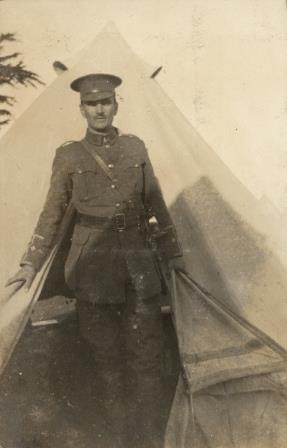
The Croix de Guerre, a French military decoration, was one of the most common medals issued by a foreign government to British and Commonwealth personnel during WWI. Translated as Cross of War or Military Cross, the medal was awarded to acknowledge heroic deeds in the face of the enemy. Foreigners chosen to receive the medal were recognised for their gallantry while directly involved with French forces, either fighting alongside them or in a feat of bravery involving one of their countrymen.
Quiet Farmer Lies in a Foreign Field
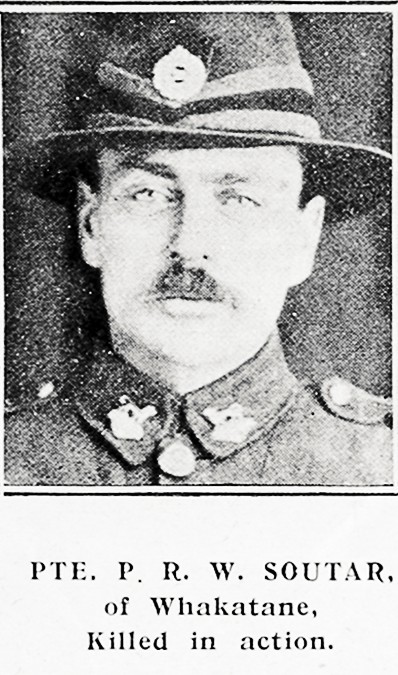
Philip Robert William Soutar was born on 18 May 1877 in Opotiki to parents Alexander and Jane Elizabeth Soutar who were originally from Scotland.
At the outbreak of World War One, Philip Soutar was farming near Whakatane. He was living with a woman known as Kathleen and had two children. He was 37 years of age, was providing some financial support to his younger sister Brenda so he was not really expected to join up.
Gunner the Afghan Kuchi Dog

Gunner was a Kuchi dog which is named after the Kuchi, a nomadic people of Afghanistan who developed the breed to guard their caravans and livestock from wolves, big cats and thieves.
It used to be quite common for military forces operating overseas to be adopted by local animals and in Gunner’s case he was only a pup when a local businessman gifted him to Kiwi Team One, a sub-unit of the New Zealand Provincial Reconstruction Team that occupied a remote base at Nayak, Yakawlang District, in Bamiyan Province, Afghanistan.
Brigadier Reginald Miles, CBE, DSO & Bar, MC

Reginald Miles served with distinction in both world wars. He began his service in Gallipoli as a forward observation officer and was wounded, but returned to duty just before evacuation in December 1915.
Following his marriage in Egypt, he served on the Somme in 1916 in command of 15 Howitzer Battery and was awarded a Military Cross (MC) for outstanding command under heavy shelling. In 1917, he took over command of 6 Howitzer Battery and in April 1918, during an attack at Ploegsteert Wood, Captain Miles fought alongside his men when the Germans almost overwhelmed them. The enemy were within 500 yards and his ammunition was exhausted. Miles rallied his men, including some infantry stragglers, and later made a reconnaissance into the wood; sending back valuable information. As he was trying to free one of his guns from the thick mud he was finally wounded by rifle-fire at close range. Recommended for a Victoria Cross, he was awarded the Distinguished Service Order (DSO).
The Amazing Life of Gladys Sandford

Not all of our Anzac wartime heroes were men in khaki. A true pioneer of her time, Gladys Sandford was a woman who achieved more firsts than many could imagine. From driving ambulances in the First World War, to becoming New Zealand’s first car saleswoman, first female pilot, first woman RSA member, and first to drive the length and breadth of Australia – this woman was well ahead of her time!
World War II Coastwatchers Remembered

New Zealand Coastwatchers who served in the Pacific during World War II were commemorated in October 2012 with the laying of a wreath at the National War Memorial in Wellington. The 15th October marks a day to remember when in 1942 on Tarawa in the Gilbert Islands, 17 New Zealand Coastwatchers and 5 civilians were executed by beheading after being captured by the Japanese.
John Jones is the last surviving member of the Coastwatchers and was in Wellington to remember his comrades, three of whom were his best friends. John was a radio operator from the Post and Telegraph Department and his job as a Coastwatcher was to keep a 24 hour watch for enemy ships and aircraft and report on meteorological conditions.